Review by Steven Maisonet
Chess, a musical with a book by Obie Award-winning playwright Richard Nelson, lyrics by award-winning songwriter Tim Rice, and music by the legendary Björn Ulvaeus and Benny Andersson – the two “Bs” of Swedish pop group ABBA – was brought to life at Lancaster Opera House, directed by J. Michael Landis and musically directed by Fran Landis. Chess, a show set around the Cold War when tensions between the US and the USSR were high, was inspired by the chess champions Bobby Fischer and Boris Spassky. Tim Rice, admiring their rivalry, later collaborated with ABBA’s Björn and Benny to develop the now critically acclaimed musical Chess.
J. Michael Landis, the director of this highly praised show, takes the audience on a walk down memory lane with his rendition, which is an admiration of the director’s note as it highlights the show’s significance and value to him. In the show’s vibrancy, the production pays homage to the ’80s, a time of revolution and musical creation from prolific performers such as Michael Jackson’s Bad album (1987), Thriller (1982), Pat Benatar’s 1980 album Crimes of Passion, and hit singles “Hit Me with Your Best Shot” and “Love is a Battlefield,” Laura Branigan’s Self Control (1984), and Nena’s 99 Luftballons/99 Red Balloons (1983). Landis captures all these elements in his directorial vision with Chess, a show that highlights a complex portrayal of the post-Cold War world, in a time when communism was to be feared. Landis, in collaboration with his production team, delivers grace, compassion, and joyous moments in this production of Chess, giving his leading principals the range to explore their deeply rooted emotions as they present a story of love, betrayal, and heartache.
Chess, in its plot, follows the rivalry between American player Freddie Trumper, played by Equity member Jacob Albarella, and Russian player Anatoly Sergievsky, played by Merrick Allen in Lancaster Opera House’s production. Although the show, eponymous to its title, follows the overarching character development of Florence, played by Emily Yancey, Freddie’s “second” – manager and strategist, a Hungarian-born asylum seeker fleeing the 1956 Hungarian Revolution. The show is introduced in a fast-paced montage of scenic elements, with ensemble members portraying Hungarian citizens fleeing the violent Soviet-occupied rebellion in Budapest. A young Florence, played by Charlotte Reisdorf, is showcased as she is witnessed playing chess with her onstage and offstage father, Gregor Vassy, played by Dan Reisdorf, who endearingly explains to his daughter Florence the history of chess. Both Dan and Charlotte Reisdorf embody a level of professionalism and artistry as they enact the show’s prologue, setting the precedent for this show.
Decades later, set in the mid-1980s, the show begins by presenting us with the first chess tournament, hosted in Bangkok, Thailand, where a hot-headed and boisterous Freddie and his second and alleged lover, now adult Florence, appear. During a tense scene with ensemble members playing reporters, Freddie, unable to compose himself, loses his temper after a reporter (played by Robert McKnight) inquires about his relationship with Florence. Additionally, on stage are Soviet Russian Anatoly Sergievsky and his second, Molokov (John May), and Freddie’s financial manager, Walter (David Bondrow).
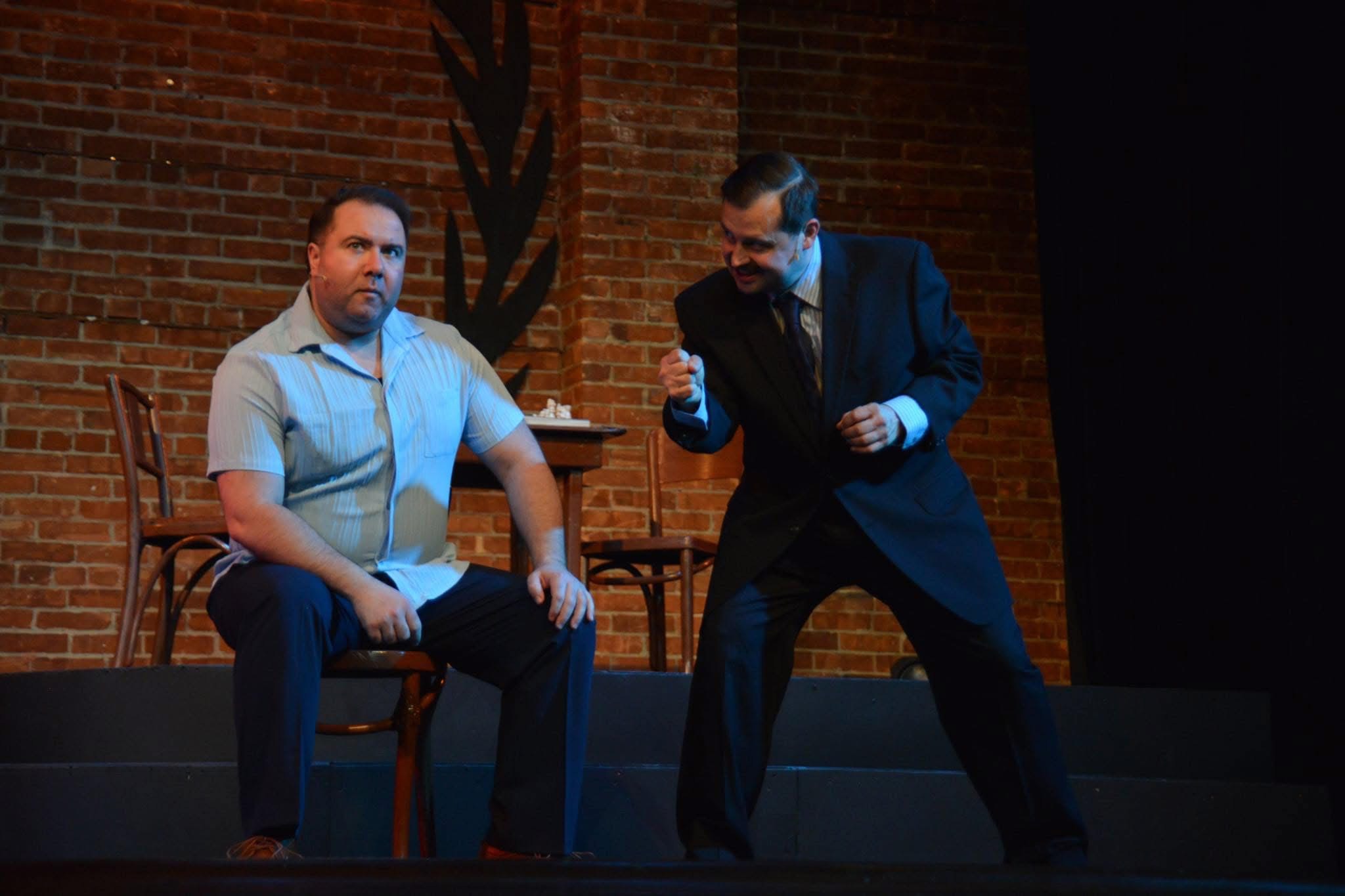
Jacob Albarella, who impressively showcased Freddie’s arrogant flairs and pompous attitude, delivers this character with ambition and precision. Albarella, whose impressive theater background stuns the audience, presumably represents patriotic American ideology. Albarella not only deliberates on these acting choices but also expressively performs his song deliveries with grace and strife. Emily Yancey, who 10/10 blew away this audience member and those surrounding, melodiously gives us a range of emotions and feelings through her performances. “Someone Else’s Story,” where she showcased her vibrant emotions and acting abilities, audaciously makes this production of Chess resonate emotionally with audience members. Merrick Allen, as Anatoly, whose long hair and clean-cut look embody the Russian persona, seamlessly transports the audience to the empathetic nature of 1980s tensions between the USSR and the US. Merrick, who last wowed the audience as Curly in O’Connell and Company’s production of Oklahoma!, continues to defy expectations with his precise theater performance and serenading voice. David Bondrow, as Walter, the seedy businessman who finds himself as the conniving deviant of this show, conveys the scheming portrayal of a shady businessman through his tactics and manipulations to gain traction and admiration for his skill as an agent. Bondrow executes on-time and quick-witted responses, highlighting the behind-the-scenes work of public relations and strategic planning involved in presenting and curating a public figure for the public gaze. Albarella’s character, Freddie, who intransigently defies Walter’s advice, finds himself in the visceral reactions of Bondrow’s emotions as he handles the frustrating disdain of having such a difficult client, bringing this character its well-presented livelihood. Opposite this portrayal is Molokov, played by Jon May, who delivers an antagonistic character and composes his illustrious mystery that draws in the audience, authentically understanding the back-end intricacies of the Russian-Soviet agent. May, who crafts the villainous vagueness, conveys the seriousness of this show’s allegorical presentation of the tensions between the US and the USSR, graciously maintaining a level of consistency in his performance, never yielding to the possibility of character growth, but instead opposing the show’s protagonists’ efforts to enact change. This portrayal is later spotlighted in his involvement in orchestrating spiteful and malicious attempts to persuade Anatoly to surrender his attributed change in character after finding comfort and passion in the arms of Yancey’s character, Florence, who swoons the audience as these two characters find a romantic thread in a politically driven story, only to later be pulled apart by the appearance of Sydney Conrad, who plays Svetlana, Anatoly’s estranged wife. Conrad, whose sweet comfort pulls at the audience’s sympathetic nature, longs for the understanding of why her husband, Allen’s character, has uprooted their life in the search for love. Conrad conveys a showcase of an apathetic and emotionless portrayal of the cold Russian personality, with few and far-between moments of authentic emotion, during scenes of warmth and comfort. This is especially evident in ‘I Know Him So Well,’ where both her character and Yancey’s character sing about their tense admiration for Allen’s character in Act 2.
Bringing this show back to the chess tournament and fascination is the Arbiter, played by Nathan Andrew Miller, whose suave portrayal of this character felt more like an emcee from Cabaret or a leading player in Pippin – showcasing Miller’s ability to regain the audience’s motivation and attention to pursue the production’s continuation. Miller draws back the audience at the start of Act 2 with the self-proclaimed song “The Arbiter’s Song,” wrangling up the ever-versatile ensemble to remind the audience of the game at large and deliver a promising story for Act 2. A notable character who found themselves playing the firm tone was Joe Greenan, who played Nikolai, a brute Russian agent who lacked any compassion for the evolving love triangle transpiring between Anatoly, Florence, and Svetlana. Greenan, who opposite this role delivered a new range of acting from his last portrayal as Data in the Star Trek musical parody Khan!, showcases his versatility and dedication to his craft, maneuvering the seriousness of being a mystery on stage while dragging along the actions conveyed to him by May’s character, Molokov. A pretty tense scene unfolded between him and Conrad’s character when he manhandled her as he was simply following orders from his commandant. Greenan consistently promises a well-presented portrayal of Nikolai.
Bringing this show to its glory is the phenomenally cast ensemble, who were given every opportunity to showcase their individuality as they switched between reporters, merchandisers in the promotional scene of “Merchandisers.” Although, on a side note, those Chess shirts employed on stage to showcase this number would have made a great profit for the show and would have been a great keepsake for those who enjoy the merchandise of theater productions. Nevertheless, the ensemble, composed of Nathanial Higgins, Rebecca Kroetsch, Lauren McGowan, Robert McKnight, Alexandra Montesano, Matt Rittler, Kristen Smigielski, Clara Tan, and Kira Whitehead, all delivered the performance of a lifetime. Each ensemble member, in their own individualized roles, showcased their versatility as dancers, singers, and actors. Memorable performances from ensemble member Alexandra Montesano, who gave the audience style and class in her role as a Southern reporter with a Tennessee accent, distributed moments of breath for the audience to digest the prior and after complications of this production’s dramatized plotline. Kristen Smigielski, whose eye-catching performance in her movements brought notice to her composure as a talented actor in the musical scene. Rebecca Kroetsch, whose soprano harmonious singing carried through the ensemble-led numbers, such as the Hungarian Folk Song, where her velvety vocals created admiration for the ensemble’s deliverance. Matt Rittler, whose cheeky confidence gave the performance in “One Night in Bangkok” added promiscuity, as the ensemble members found themselves as a group of heated tourists in the red-light district of the city, as they all stripped in their undergarments to deliver performances and vocals. Robert McKnight, whose vibrant and charismatic energy brought joy to his performance, Nate Higgins, who delivered comedic timing as his portrayal of security personnel and awkward moments in his foot-in-mouth lines that brought comedic elements to the show. Lauren McGowan, who showcased her diverse range in her characters, and lastly, Clara Tan and Kira Whitehead, who gave Grace Jones and Eurythmics vibes to the stage in this ’80s-themed production with their sleek, chic styling as they appeared to be important characters in the chess championship, giving the production grace and elegance.
From the abroad scene and intensity of this show, it was masterfully crafted by Tara Kaczorowski, who subtly embedded “Love is Battlefield” by Pat Benetar into the show’s ambience, as Yancey’s character and the ensemble gave subtle nods to the 9-5 working style in “Nobody’s Side.” Additionally, incorporating Michael Jackson movements in the Arbiter’s song, a true homage to the show’s ‘80s style. As this show is a musical, the simplicity of the choreography was not lost, as it carried itself in the other aspects of dialect, storytelling, and vocal performance, making this show’s choreography truly notable as a moment of greatness. On the note of the ’80s, this show gave us wardrobe truly representative of the time, with its integration of styling such as padded shoulder blazers, athletic-style outfits, color schemes, and patterns – all made possible by the talented work of Elaine Heckler (Wardrobe) and Timmy Goodman (Costume Designer), and hair and makeup that highlighted the ‘80s vibrancy in styling and hair by hair and makeup designer Valerie Sember. Visual aspects of this show created transitions and atmospheric elements through their lighting design. A notable mention goes to the lighting design by Kimberly Pukay. Although there were some scenes where the lighting appeared too harsh on the characters, a warmer or rose-colored element may have softened the characters’ abrasiveness in lighting, the show did not fail in this aspect. As always, the use of a live orchestra brought this show its flexibility in range and adaptability in the actors’ performances, all thanks to the musical direction of Fran Landis and the orchestra: Violin: Ted Smeltz, James Ieda, Jenna Noreck; Cello: Andrew Borkowski, Doug Shaw; Flute/Piccolo: Nicole Murray; Clarinet: Rachel Selice, Dan Cassidy; Oboe/English Horn: Sheryl Rohr; French Horn: Kate Fridmann; Trumpet: Aaron Scoccia; Trombone: George Kroetsch, Pim Liebmann; Drums: Nick Corallo; Percussion: Kris Banzhaf; Keyboard: Fran Landis; Bass: Jay Wollin; Guitar: Larry Albert.
The show’s production team created a well-rounded, simple stage design for these actors to explore their craft. The set design, although minimal, was useful as characters shifted in and out of quick costume changes and gave prompt entrances as scene changes occurred, an intentional design composed by set designer Lou Iannone. Stage management by Madge Bellanti transitioned smoothly and effortlessly, with the assistance of soundboard and lighting board operators J. Michael Landis (soundboard operator) and Victoria Padilla (lighting board operator), as well as integral moments of spotlight by Laura Rast (spotlight operator). No dialect coordinator was employed, although unnecessary, given this show’s diverse employment of various accents, which was not lost in each actor’s ability to dialectically transform their syntax throughout their various characters.
Chess, based on an idea by Tim Rice, lyricist of Joseph and the Amazing Technicolor Dreamcoat, Jesus Christ Superstar, and Evita, and featuring an iconic score from ABBA’s Björn and Benny, remains a beloved cult classic in musical theater. In this groundbreaking rock musical, chess becomes a metaphor for Cold War politics, international intrigue, and romantic dilemmas. Songs like Anthem, One Night in Bangkok, and Pity the Child have made Chess a standout in musical history.
Running from March 28 to April 13, 2025, Chess can be seen at the majestic Lancaster Opera House. Tickets are available online at Lancaster Opera House or at the box office. The theater offers convenient parking across the street, and light snacks and drinks are available for purchase. Don’t miss this extraordinary production of Chess, which will transport you back to the 1980s with its music and costumes.