
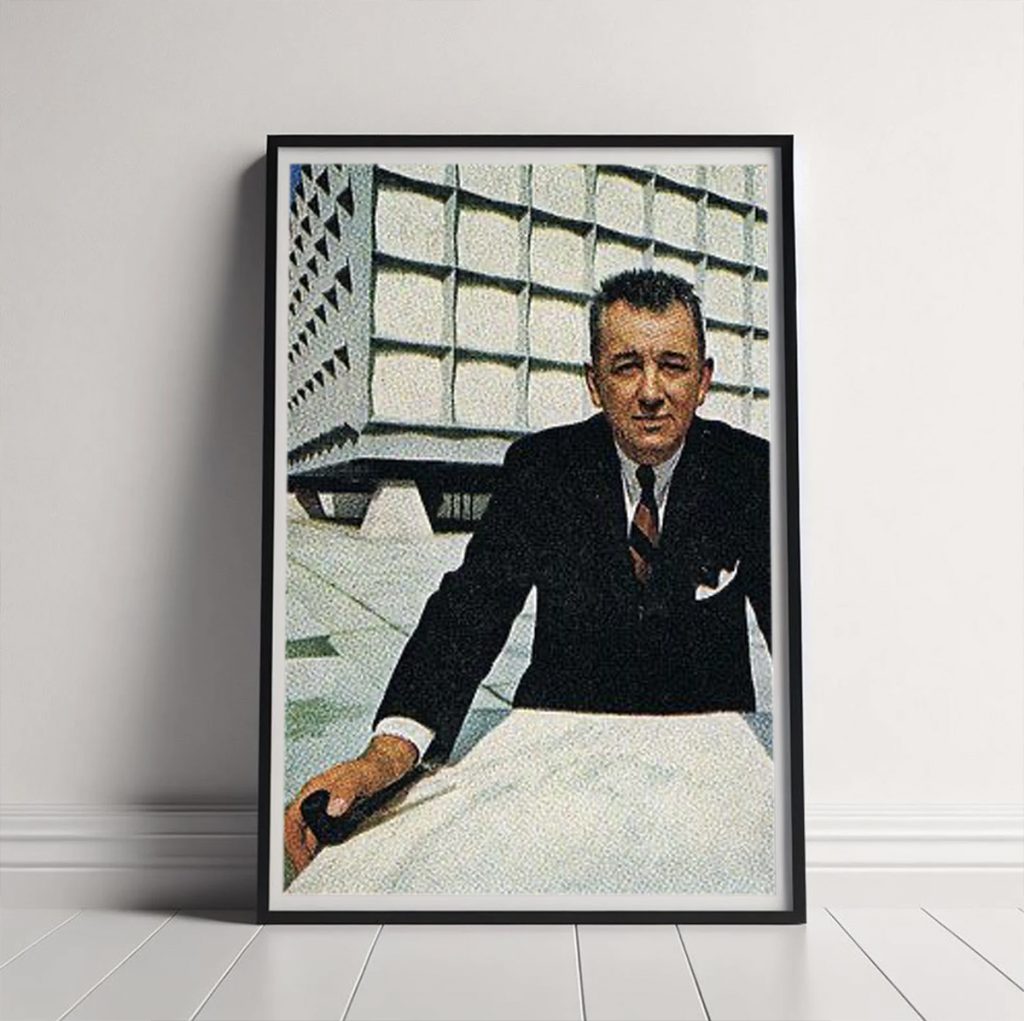
Gordon Bunshaft
Architect
About Gordon Bunshaft
Gordon Bunshaft – Buffalo’s Trailblazing Modernist Architect
Buffalo, NY, has long served as the birthplace of trailblazers across various fields, and the story of Gordon Bunshaft, born on May 9, 1909, stands as a shining example in the world of architecture. With a career defined by innovative modernist designs and a bold architectural philosophy, Bunshaft left an indelible mark on the 20th-century skyline, reshaping how we think about corporate and cultural spaces.
Early Life and Roots in Buffalo
Gordon Bunshaft was born in Buffalo to Russian Jewish immigrants, David and Yetta. The family lived modestly, but even as a child, Bunshaft showed an extraordinary talent for drawing and design. His artistic potential first caught the attention of a family doctor, who encouraged his mother to pursue architecture as a career path for her son.
Bunshaft attended Lafayette High School in Buffalo, where he continued to cultivate his passion for design before earning both his undergraduate and master’s degrees from the Massachusetts Institute of Technology (MIT). His academic success at MIT earned him a Rotch Traveling Scholarship, which gave him the opportunity to study classical architecture across Europe from 1935 to 1937. It was this blend of classical inspiration and a modernist vision that would define his storied career.
Career Highlights with Skidmore, Owings & Merrill
Gordon Bunshaft began his profession at the legendary architectural firm Skidmore, Owings & Merrill (SOM), joining the team in 1937. Over four decades, he became one of the firm’s defining voices, crafting iconic structures that stood as milestones in the International Style of modern architecture. His designs emphasized clean lines, functionality, and the innovative use of materials that blended aesthetics with practicality.
Perhaps his most famous work was New York City’s Lever House, completed in 1952. This groundbreaking glass skyscraper became a symbol of postwar modernism and a trailblazer for curtain-wall architecture in commercial design. The Lever House not only transformed New York’s skyline but also served as a model for corporate America, signaling a progressive and forward-thinking approach to urban office spaces.
Bunshaft’s portfolio with SOM also includes masterpieces like the Beinecke Rare Book and Manuscript Library at Yale University, notable for its translucent marble walls that filter light into the building while protecting its valuable contents from the sun. Similarly, the Hirshhorn Museum and Sculpture Garden in Washington, D.C., a distinctive cylindrical structure surrounded by a verdant sculpture garden, reflects Bunshaft’s ability to harmonize form, function, and setting.
His other notable projects include 140 Broadway in New York, the Lyndon Baines Johnson Library in Texas, and the National Commercial Bank in Jeddah, Saudi Arabia. Each of these designs exemplifies his commitment to functionality and modern elegance, creating spaces that not only serve practical purposes but also inspire wonder.
Contributions to Modern Architecture
Gordon Bunshaft’s influence on architecture is difficult to overstate. He was an architect who viewed buildings as more than structures—they were symbols of societal progress, innovation, and identity. By working closely with corporate leaders, he tailored highly personalized designs that celebrated the values of their companies. This collaborative approach marked one of the defining cultural shifts in mid-century architecture.
Bunshaft was also known for his refusal to compromise his principles, maintaining that architecture should respond to its time and location. This outlook positioned him as a staunch modernist, critical of postmodern trends he saw as arbitrary and disconnected from the discipline’s logical roots.
His designs have been celebrated with numerous accolades, including the prestigious Pritzker Architecture Prize in 1988, which he humbly referred to as the “capstone” of his architectural career.
Legacy in Buffalo and Beyond
Even as Gordon Bunshaft’s career took him to global prominence, his ties to Buffalo remained an essential part of his story. His parents’ immigrant roots, his years in the city, and the encouragement he received from those who recognized his talent were the seeds of his eventual success.
Today, Buffalo can proudly claim Bunshaft’s influence, as his architectural ethos echoes in the city’s own historic and modern structures. His addition to the Albright-Knox Art Gallery—a sleek, elegant space completed in 1962—remains a testament to his dedication to balance and innovation.
Bunshaft’s career has inspired generations of architects to think beyond traditional modes of design, blending artistic vision with modern needs. His work continues to be studied in architectural programs around the world, and his projects remind us of the power of design to shape cultural and urban landscapes.
Ongoing Influence
Though Gordon Bunshaft passed away in 1990, his impact continues to resonate in the field of architecture. His designs remain timeless examples of functionality fused with elegance, and his philosophy of modernism serves as a guiding light for architects striving to marry innovation with purpose.
For Buffalo, Gordon Bunshaft represents the best of what the city can offer—a place where creativity is nurtured, ambition takes flight, and the world is left transformed. His legacy stands tall, not only in the sweeping glass of Lever House or Yale’s marble-clad Beinecke Library but also in the enduring inspiration he has offered to the design world. Gordon Bunshaft remains, without a doubt, one of Buffalo’s greatest gifts to modern architecture.