
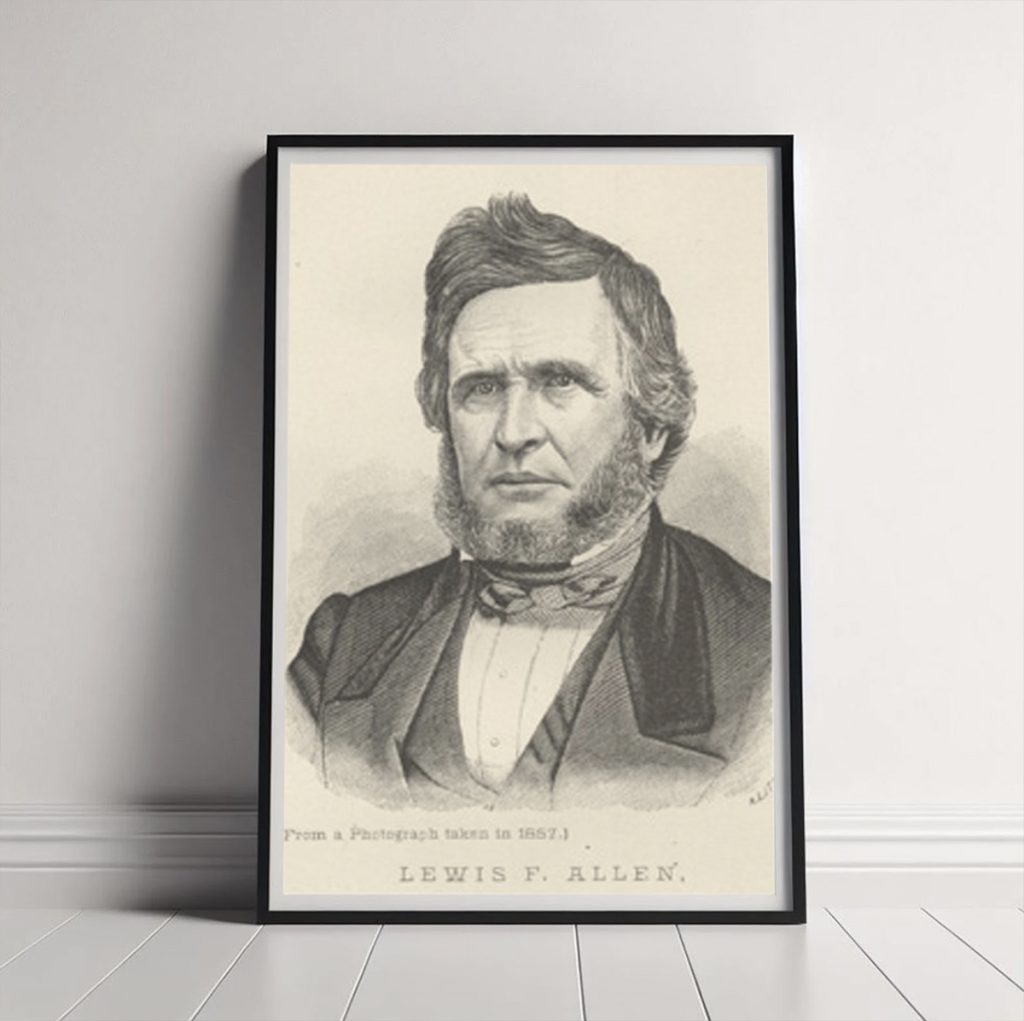
Lewis F. Allen
Business
Farmer
Politician
About Lewis F. Allen
Lewis F. Allen: Buffalo’s Pioneer in Agriculture and Civic Leadership
On January 1, 1838, Buffalo, New York, saw the birth of a man who would play a pivotal role in shaping its agricultural and civic landscape—Lewis F. Allen. Known for his forward-thinking approach to land development and his contributions to the community, Allen’s impact extended far beyond his farm and resonated deeply with Buffalo’s growth during the 19th century.
A Life Rooted in Agriculture
Growing up in Buffalo during a time of rapid expansion, Lewis F. Allen was surrounded by opportunity. The fertile lands of Western New York, coupled with the city’s position as a trading hub on Lake Erie, provided an ideal setting for agricultural innovation. With a strong passion for farming and a keen interest in improving agricultural practices, Allen devoted his life to enhancing the productivity and profitability of farming.
Allen’s contributions to agriculture were marked by his belief in modernization. At a time when many farmers relied on traditional methods, he advocated for the adoption of advanced techniques and selective breeding programs to improve the quality of livestock and crops. His farm became a model of innovation, attracting attention and admiration from farmers across the region.
The Birth of the American Polled Hereford
One of Lewis F. Allen’s most notable contributions to agriculture was his role in introducing and popularizing new cattle breeds in the United States. He was instrumental in promoting the American Polled Hereford, a breed recognized for its adaptability, hardiness, and high-quality beef. This endeavor not only revolutionized the cattle industry but also boosted Buffalo’s reputation as a center for agricultural progress.
Allen’s meticulous records on livestock breeding set a standard for future agriculturalists. His work was later compiled into valuable publications that served as reference materials for farmers across the country.
Civic Leadership and Buffalo’s Growth
Beyond the world of farming, Lewis F. Allen was a dedicated civic leader. He believed that the prosperity of Buffalo depended on the well-being of its citizens and the careful development of its resources. Allen served in various leadership roles within the community, advocating for infrastructure improvements, better educational opportunities, and public health initiatives.
The development of parks and green spaces in Buffalo was also an area of great interest to Allen. He understood the importance of nature in urban settings and worked to ensure that the city’s rapid expansion didn’t come at the expense of its environment. His efforts helped lay the groundwork for Buffalo’s future focus on livability and sustainability.
Anecdotes and Lesser-Known Facts
Lewis F. Allen was much more than an agriculturalist and civic leader—his personality and actions revealed a man deeply committed to his values. One fascinating story highlights his natural inclination for mentorship. Among Allen’s associates was his young nephew, Grover Cleveland, who would go on to become the 22nd and 24th President of the United States. Cleveland worked as a clerk on Allen’s farm during his early years, and it’s said that Allen’s work ethic and principles left a lasting impression on his nephew.
Allen was also a prolific writer, contributing essays and guides on best farming practices. His writings showcased his belief that farming was not merely an economic venture but a noble endeavor that required respect for the land and a progressive mindset.
A man of innovation, Allen was one of the first in Buffalo to experiment with hybrid seed development, seeking to create crop varieties that were more resistant to disease and better suited for the region’s climate. While these early experiments were not as advanced as modern genetics, they marked Allen as a forward-thinker in a time of agricultural transformation.
A Legacy of Innovation
Lewis F. Allen’s contributions to Buffalo and beyond are undeniable. Through his dedication to agriculture and civic leadership, he carved out an enduring legacy of innovation and community service. His vision helped shape Buffalo into a city that was not only industrially powerful but also agriculturally advanced.
Buffalo, in turn, provided Allen the perfect canvas for his work. Its fertile lands, strategic position as a trade hub, and spirit of resilience were the ideal ingredients for fostering his ideas and initiatives. Allen’s efforts didn’t just benefit the farmers of Buffalo—they set a precedent for agricultural practices across the nation.
Today, Lewis F. Allen is remembered as a pioneer whose contributions went beyond crops and cattle. His vision for progress, paired with his unwavering commitment to his community, has left a legacy that continues to inspire. On January 1, as we reflect on his birthday, we celebrate not just a man but a philosophy of innovation, hard work, and care for the land and the people who call it home.