Review by Steven Maisonet
Synopsis–
In The Niceties by Eleanor Burgess, an accomplished Ivy League professor holds routine office hours with an ambitious young student to discuss her thesis: If history is written by the victors, who tells the story of the oppressed? Before long, quibbles over vocabulary and Wikipedia citations turn into a dangerous discourse as both women passionately defend their perspectives and worldviews—until one of them puts everything on the line to make her case.
With a fitting title for such a complex and relevant production, this play resonates especially well in today’s socio-political climate, particularly regarding the intersectional identities of Black, Indigenous, Latinx, Asian, or other people of color, and their experience as college students in America. Set predominantly in 2016, The Niceties takes the audience on a historical journey through the American Revolution, led by Dr. Bosko’s academic interpretation of what she would defend as a radicalized theory of America’s foundation.
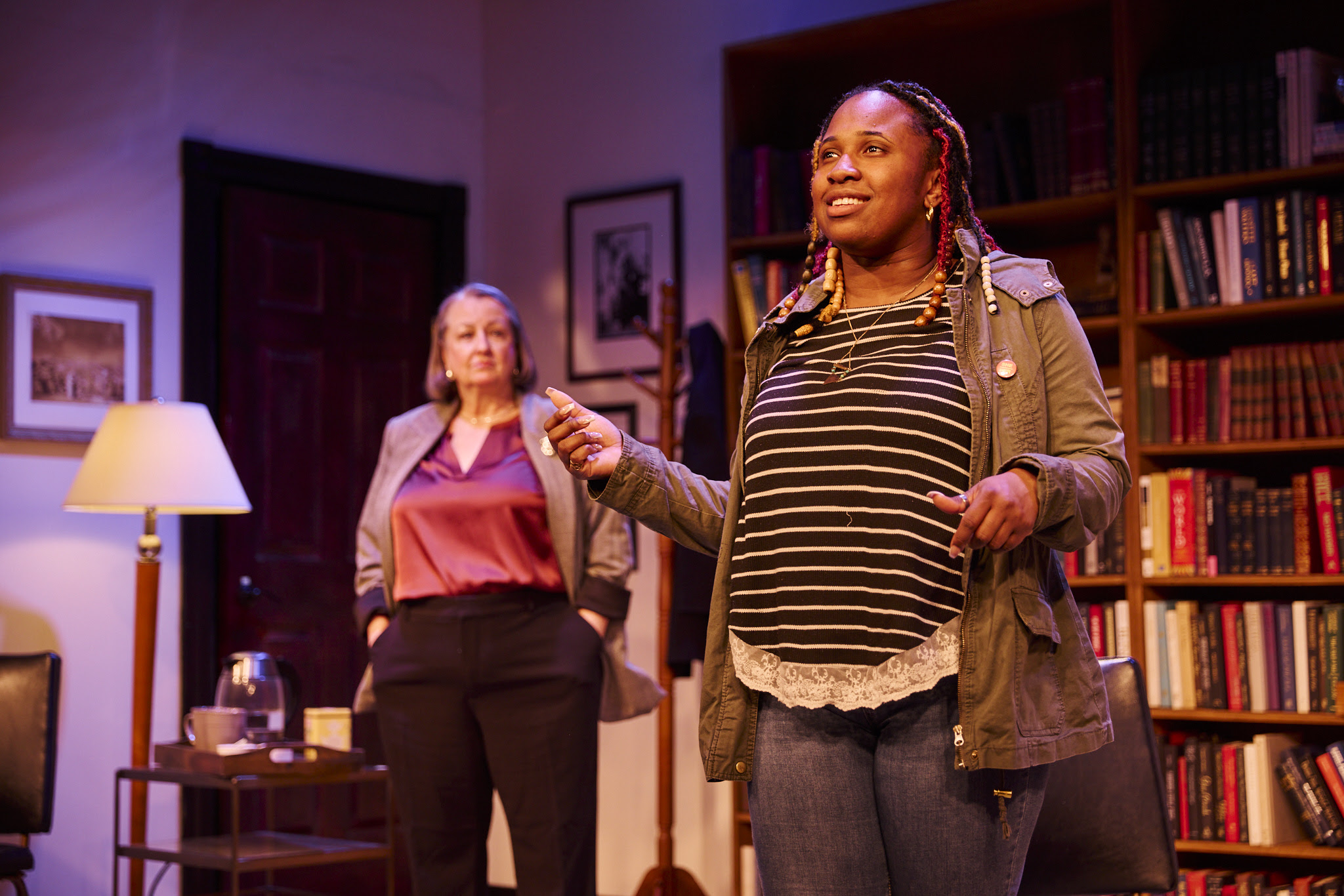
The 2nd Generation Theatre production of The Niceties, directed by Gabriella Jean McKinley, is a remarkable achievement. McKinley expertly brought the show to life, highlighting both actors’ empathetic and passionate drives for validation. She outdid herself with exceptional attention to detail in every aspect of the production. From the scenic composition, with the opening quote projected on the stage’s mantel— “I beseech you, in the bowels of Christ, think it possible you might be mistaken” (Learned Hand, a potential red herring for those familiar with the show)—to the transformation of the Shea Smith Theatre into an academic space that felt all too familiar.
The meticulously crafted props and books invite us into Dr. Janine Bosko’s office hours. This is hands-down one of the best scenic designs I have seen on this stage.
Dr. Janine Bosko (Pamela Rose Mangus), an academic historian and tenured professor, finds herself at the center of a term that gained traction in 2016, commonly known as “cancel culture” or “call-out culture.” When put on the spot by her political science student, Zoe Reed (Anika Pace), who seizes the opportunity to hold her professor accountable after a heated argument, the dynamics of power imbalances in educational institutions and systemic oppression come to light. Mangus does an exceptional job portraying the tenacious historian in her role as Janine, mastering one of the most challenging roles—a stubborn, uninformed individual who is blatantly complicit in their biases.
Mangus, well-known for her charismatic demeanor and sensible approach, was last seen as the spunky, cynical, and hilarious Martha Brewster in Lancaster Opera House’s production of Arsenic and Old Lace. Now, she plays a radically persistent lesbian professor who fought for her seat at the Ivy League table, in a department often dominated by white, cisgender, heterosexual men. Mangus’ portrayal of Professor Bosko, a 3rd-generation descendant of the first female students enrolled in the fictitious Ivy League school, forces the audience into uncomfortable territory as we witness a tense and heated argument about the real struggles Black Americans endured during early American civilization. The disagreement escalates, with both characters intransigently unable to find validity in the other’s argument. This culminates in a stand-off, ending Act I in a riveting manner.
Zoe, played by Anika Pace (last seen as May in Junie B. in Jingle Bells Batman Smells at Buffalo’s Theatre of Youth), embodies the role of an activist and changemaker with fervor. Pace’s portrayal of Zoe’s passionate arguments about the systemic oppression and marginalization of African Americans during the founding of white supremacist culture in America is nothing short of mesmerizing. Her character consistently meets Janine’s rebuttals, forcing the professor to confront her unacknowledged advantages as a white woman in academia. The scene grows even more cynical as Mangus’ character tries to dominate Zoe, using her power over academic evaluations to intimidate her into abandoning her beliefs. Pace’s portrayal of Zoe’s righteous rage is exemplary, and she delivers her lines with remarkable composure, creating a tense and dramatic moment between the two actors.
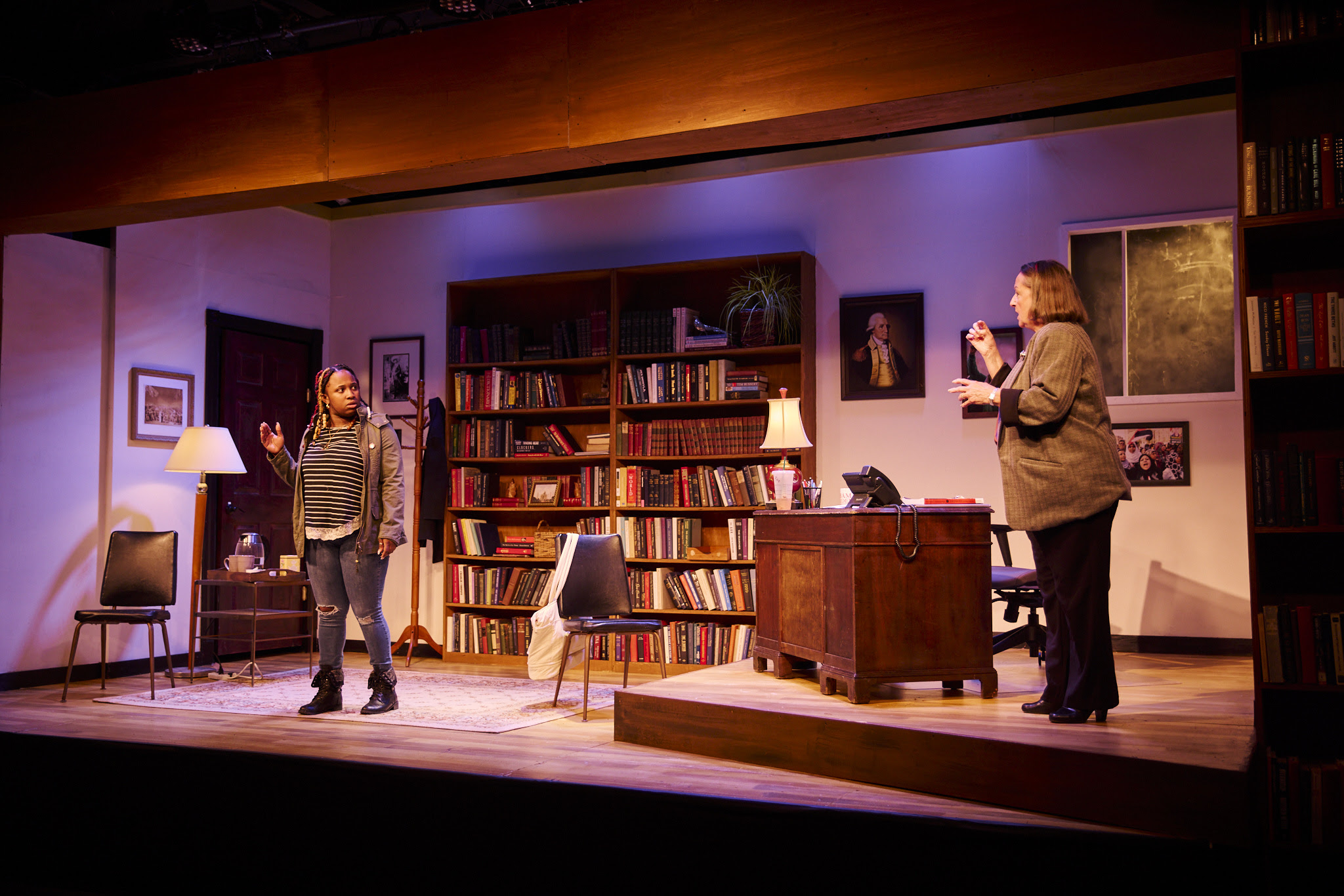
In Act 2, the characters return to their conversation weeks after their explosive argument. Both actresses now express remorse for their roles in what became a marketable debate on power and privilege in academia. The environment remains hostile, with McKinley’s brilliant stage blocking emphasizing the distance between the two characters. This was a particularly notable element of the production, as I’ve had the privilege of participating in an acting empathy workshop facilitated by McKinley at the Ujima Company’s Lorna C. Hill Theater, in conjunction with Buffalo State University’s Anne Frank Project during 12 Mo’ Angry Men.
Now, both characters attempt to address the institutional marginalization of historically oppressed groups by outlining strategies for creating equitable spaces on campus for minority students. But once again, resistance from Mangus’ character, Janine, demonstrates her inability to offer compassionate guidance. Her responses contradict Pace’s character, Zoe, whose enthusiasm for social justice and anti-oppressive practices in educational spaces becomes more evident in her dream of a student body that truly represents America. The actresses’ emotional performances create a dynamic tension on stage, where the venomous remarks exchanged between the characters shed light on the real, ongoing societal dilemma of educational reform.
The production’s attention to every detail, including the set design, was masterfully executed by Diane Almeter Jones (Properties Design) and Spencer Dick, whose collaboration created one of the most effective and visually striking sets I have seen in Western New York theater. The costumes, designed by Amaya Mack, reflect the contrasting personalities of the characters—Mangus’ character is elegantly chic in a crimson blouse and gray blazer, exuding professionalism, while Pace’s character is dressed in casual athletic wear, perhaps signifying Zoe’s on-the-go, activist lifestyle. Lighting and Sound Designer Chris Cavanagh provided minimal overhead lighting, with cool vibrant lights contrasting the set’s academic atmosphere with spatial lighting that highlighted the characters at all times. Emma English (Stage Manager) delivered meritorious set directions throughout the run and during intermissions, as observed.
The production also benefited from the insightful work of dramaturg Nicole Morris Johnson, a scholar and assistant professor of African American and Caribbean Literature, Culture, and Theory. Her expertise was invaluable in ensuring historical accuracy and cultural representation within the play. As Morris Johnson highlighted in a quote from playwright Eleanor Burgess in the Playbill: “We either have conversations with people we agree with, or we back out of a conversation the second it gets uncomfortable. The cathartic release of THE NICETIES is that neither of these characters will give up, so they follow that conversation all the way through, and the audience gets to follow through to the wreckage they create.”
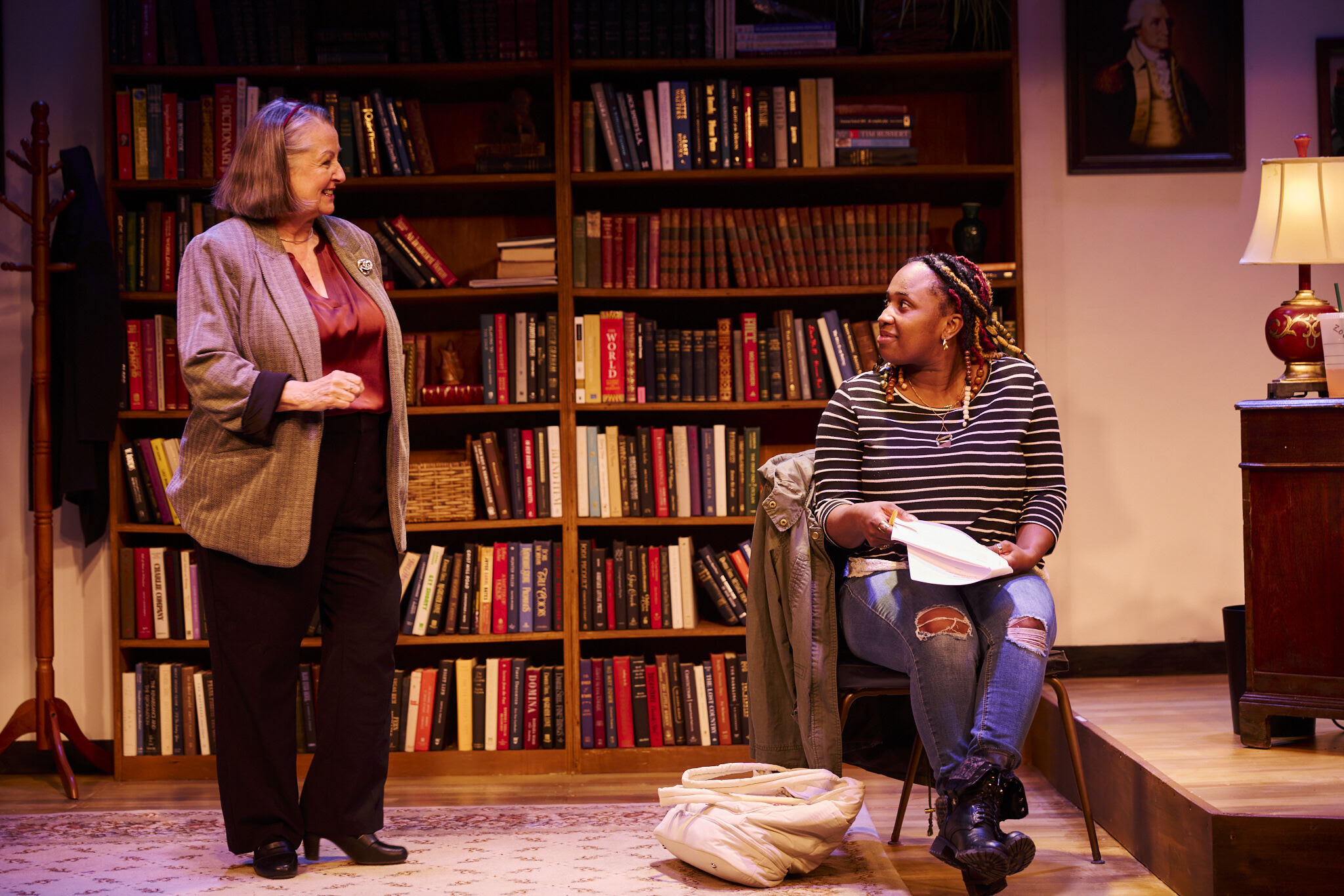
As delivered, this production has left the audience intellectually challenged and eager to continue the conversation. I witnessed this firsthand during post-show discussions at a local bar with cast members and audience members. The Niceties addresses ongoing conversations that are now more important than ever. 2nd Generation Theatre has cultivated a significant and timely production, reminding us of the importance of being anti-racist in America.
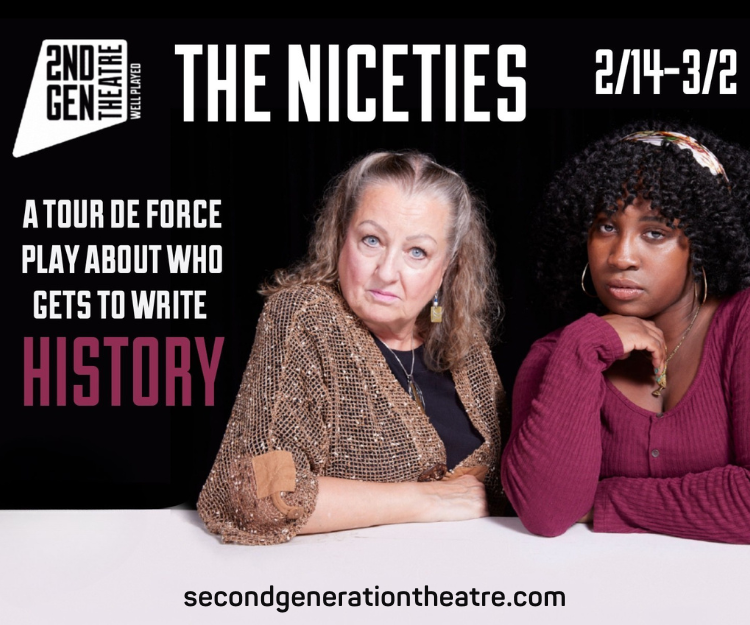
The Niceties, which opened on Valentine’s Day (February 14) and runs through March 2, can be seen at the Shea’s Smith Theatre, located in the lovely theater district downtown at 658 Main Street, Buffalo, NY. Tickets can be purchased via the box office in person or online at 2nd Gen’s website: secondgenerationtheatre.com or Sheas.org.
PERFORMANCE DATES:
Feb. 14 – Mar. 2, 2025
Shea’s Smith Theatre
Thursdays @ 7:30 pm
Fridays @ 7:30 pm
Saturdays @ 8:00 pm
Sundays @ 2:00 pm
Join the Director, Cast, and Guest Panelists for Post-Show Discussions on 2/16, 2/27, and 3/2.